2026-07-03
XERF Series Part 5 - Why Are ‘Retaining Ligaments’ and ‘Design’ Important in Lifting?
Discover why effective RF lifting goes beyond just tightening the skin. Learn how targeting retaining ligaments and customizing the treatment design are crucial for optimal facial rejuvenation.

During lifting consultations, many people tell me:
‘I feel like my skin is sagging a bit.’
‘My nasolabial folds have gotten deeper.’
‘My jawline isn't as sharp as it used to be.’
In these cases, it is easy to think of lifting as a procedure that simply tightens the skin.
However, facial sagging is actually not just a problem of a single skin layer.
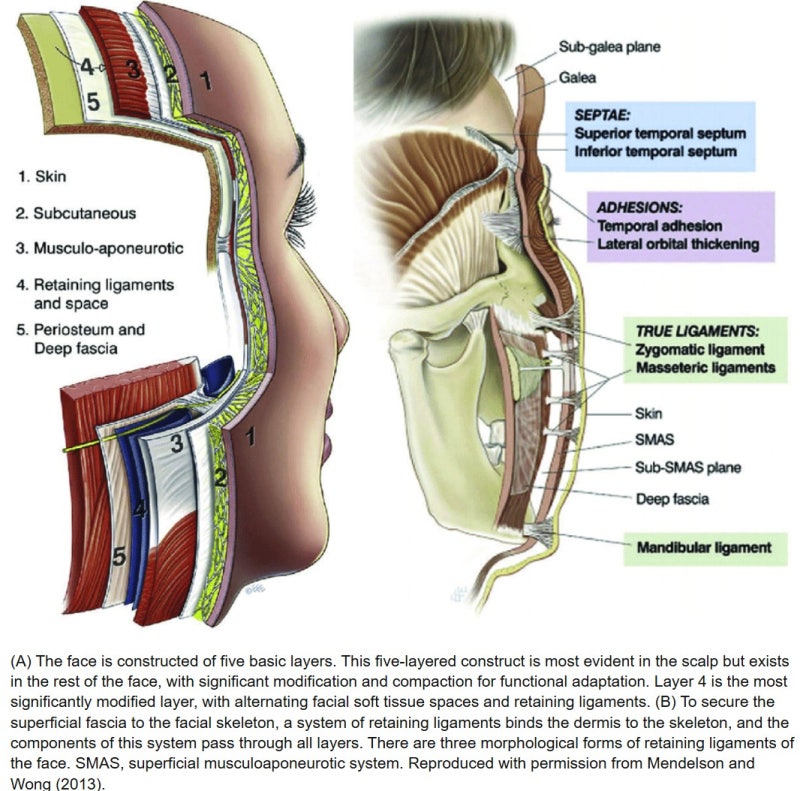
The face is a three-dimensional structure composed of:
Skin
Fat
SMAS
Fibrous support structures
Retaining ligaments
working together, and aging progresses simultaneously across all these layers.
Today, I will easily explain why retaining ligaments are important in lifting and why the treatment design determines the results, based on recent research papers.
1️⃣ Why Does the Face Sag?
Explaining facial sagging simply as ‘a loss of skin elasticity’ is insufficient.
As we age, the face experiences a combination of:
Decreased skin collagen
Reduced dermal elasticity
Fat migration
Weakening of fibrous support tissues
Loosening of retaining ligaments.
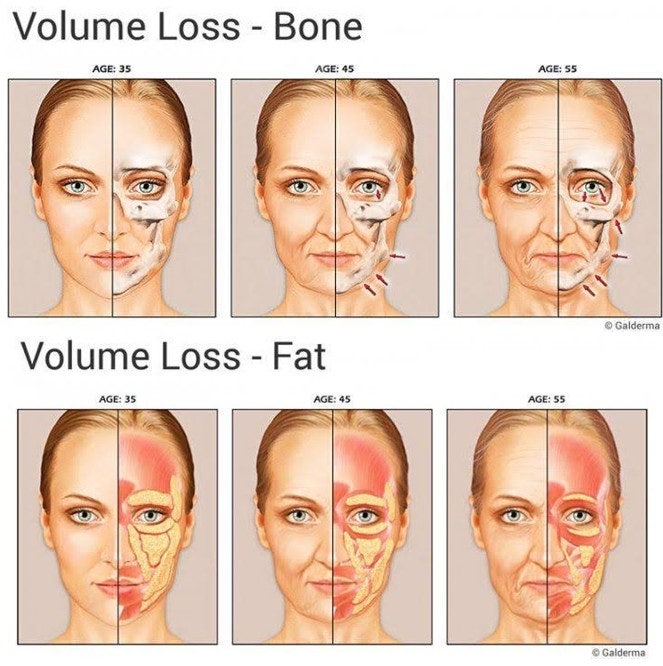
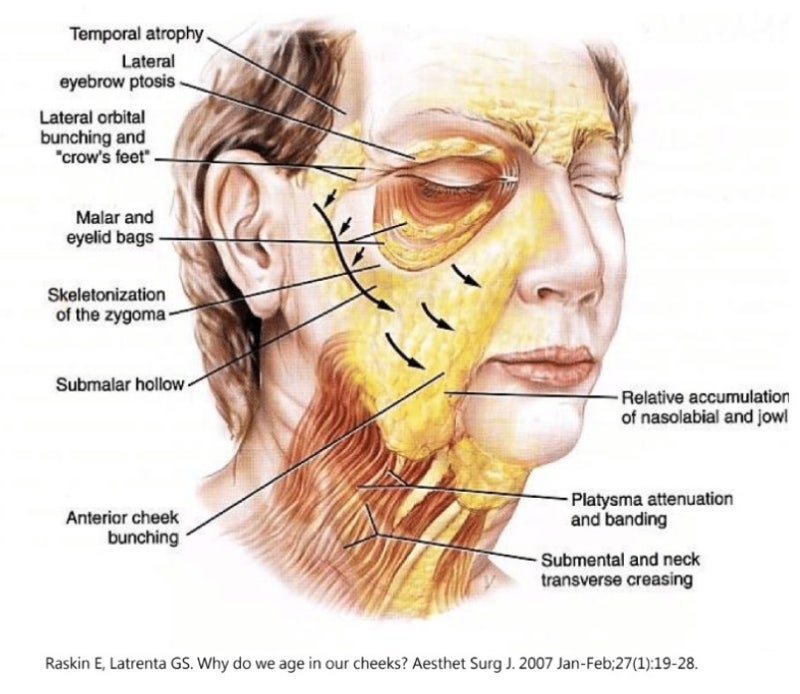
In other words, the face does not just have stretching skin;
the very structures holding the face in place weaken, causing it to sag downwards.
Therefore, over time,
Nasolabial folds deepen,
Marionette lines form,
The jawline collapses,
And cheek sagging becomes more prominent.
2️⃣ What Role Do Retaining Ligaments Play?
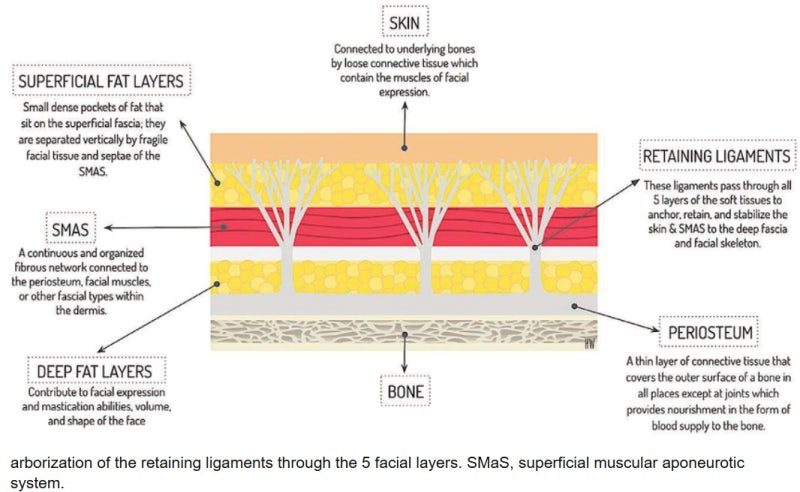
Retaining ligaments are support structures that anchor the skin and soft tissues to the underlying structures.
Simply put, you can think of them as
anchoring straps or supports that help keep facial tissues in their proper place.
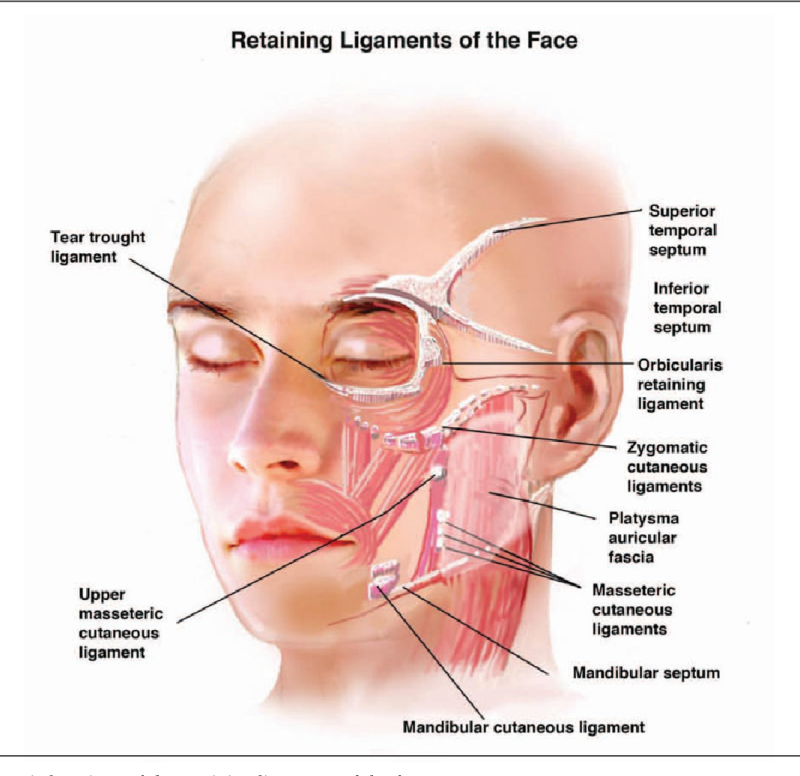
When these structures are healthy, the volume and weight of the face are maintained relatively stably.
However, as aging progresses,
The collagen around the retaining ligaments weakens,
The fibrous structure loosens,
The strength to support the tissues decreases,
And the facial soft tissues gradually migrate downwards.
Ultimately, lifting is not just an issue of the skin surface;
how we understand and approach these support structures is crucial.
3️⃣ Recent Studies Show RF Can Also Affect Collagen Changes in Retaining Ligaments
Previous papers on RF lifting primarily focused on:
Dermal collagen contraction
Collagen regeneration
Skin tightening
Fine line improvement.
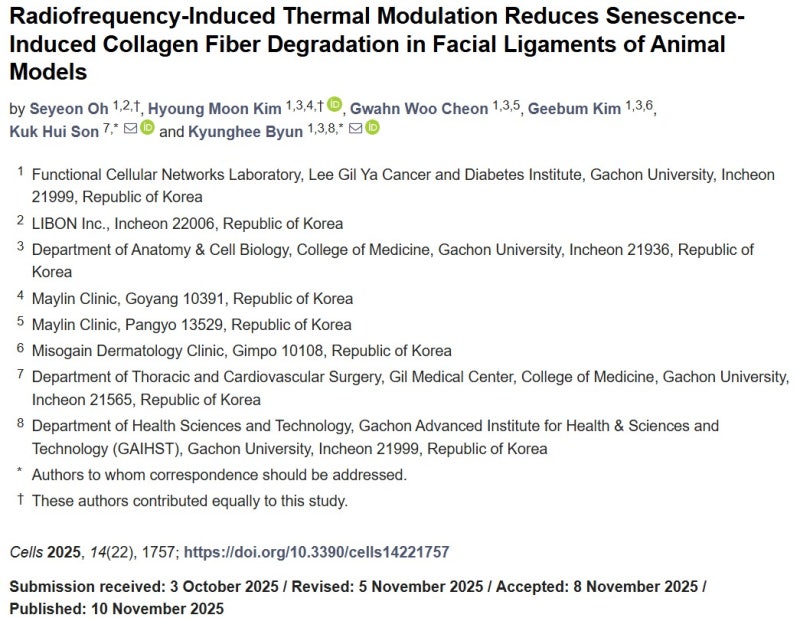
However, a recently published study went a bit deeper
👉 to examine how RF can affect collagen changes in the retaining ligaments of an aging face.
Although this study is a preclinical study based on cell experiments and animal models rather than human clinical trials,
it holds quite interesting implications for understanding lifting.
4️⃣ Key Takeaway from the Study: RF Creates Reactions Beyond Simple ‘Heat’
In this paper, the researchers observed that
RF does not merely heat the tissue to cause momentary contraction,
but also has the potential to induce molecular signal changes inside the cells.
What they found particularly important is HSP70.
HSP70 is a protective protein that responds to heat stimulation,
playing a role in reducing damage and helping cells react towards recovery when under stress.
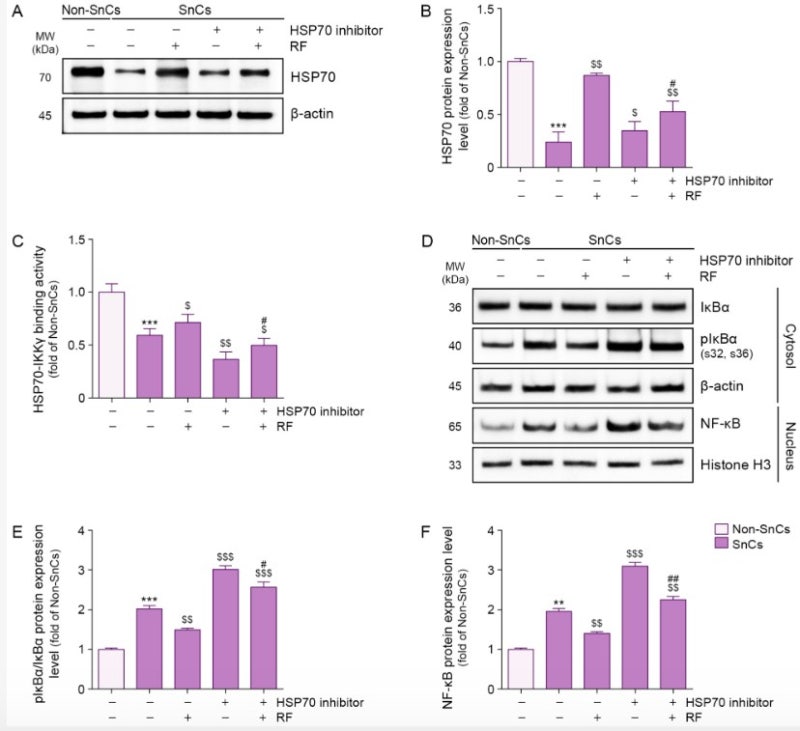
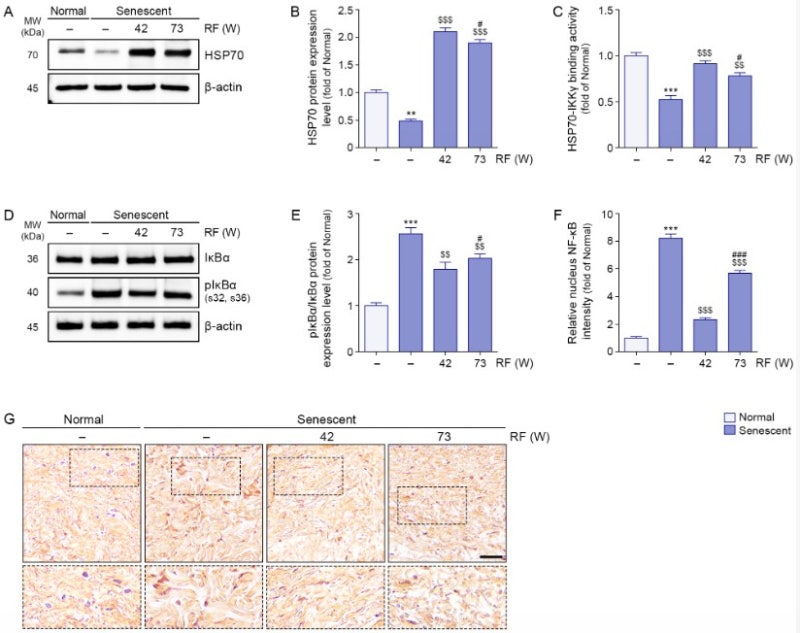
The study observed that after RF irradiation, there was:
Increased HSP70 expression
Increased binding of HSP70 and IKKγ
Decreased IκBα phosphorylation
Decreased NF-κB activity.
To put it simply, aging tissues tend to lean towards inflammation and degradation,
but RF showed the potential to partially mitigate this trend,
helping the tissue degrade less and move towards a more stable state.
5️⃣ Why Is This Important?
Because it reduced collagen-degrading signals and increased recovery signals.
The study showed that after RF, the expression of enzymes related to collagen degradation decreased, including:
MMP1
MMP2
MMP3
MMP9.
MMPs are, simply put, enzymes that act to break down collagen and the ECM (Extracellular Matrix).
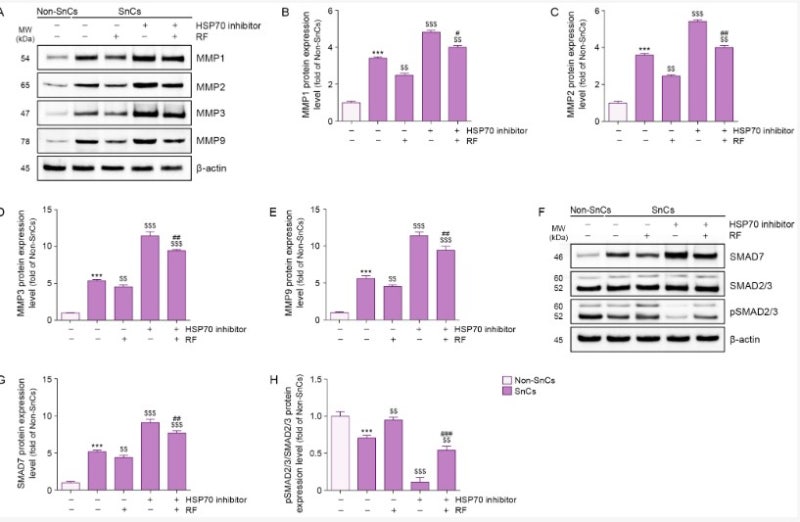
As aging progresses, these degradation signals increase,
causing collagen fibers to break more easily, become more disorganized, and weaken.
Conversely, this study also observed that after RF, there was:
Decreased SMAD7
Increased pSMAD2/3.
This can be interpreted as a favorable environment for collagen production and remodeling.
In other words, RF does not simply ‘tighten,’
👉 but shows the potential to induce a state where collagen degrades less and recovers into a more organized structure.
6️⃣ What Changes Were Actually Seen Inside the Retaining Ligaments?
The reason this paper is interesting is
that it looked at tissue-level changes as well as molecular changes.
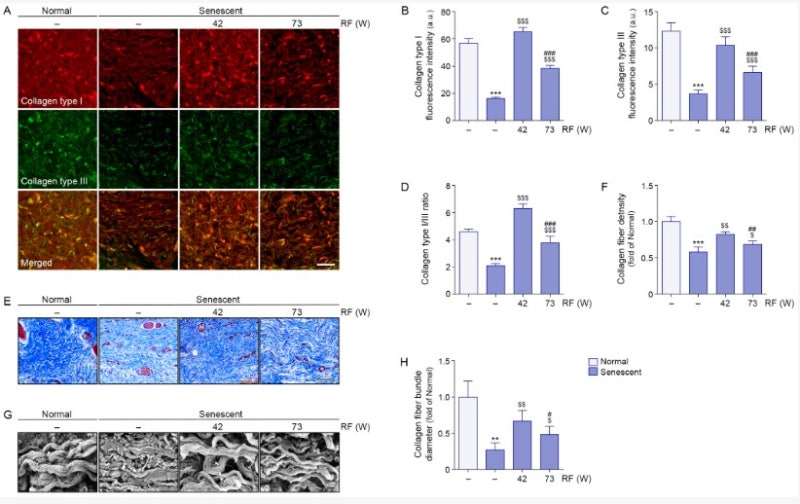
In aged retaining ligaments, the following were observed:
Decreased collagen density
Thinner collagen bundles
Increased fiber fragmentation
Loss of helical structure.
Simply put, the support structure that should originally be dense and organized
had changed into a thinner, broken, and disorganized state.
However, after RF irradiation, the following were confirmed:
Increased collagen density
Increased collagen bundle diameter
Recovery of the collagen type I / III ratio
Partial recovery of fiber alignment and helical structure.
In short, 👉 it was observed that the loose and weakened collagen structure of the retaining ligaments changed towards a more organized direction.
Of course, based on this study alone,
we cannot definitively conclude that ‘RF directly lifts retaining ligaments in human faces.’
But it at least provides a basis to understand lifting not just as a skin surface issue,
but from the perspective of remodeling the entire facial support structure.
7️⃣ Important Point: Stronger Is Not Always Better
Another interesting part of this paper is
that higher energy did not always yield better results.
The study compared 42W and 73W,
and across several indicators, 42W actually showed a more favorable response.
This provides a very important message for lifting procedures.
Many people think, ‘Doesn't higher energy mean stronger lifting?’
but actual tissues are not that simple.
Excessive heat can lead to pain, undue stress, and unnecessary tissue reactions,
and it does not always mean better remodeling.
In other words, 👉 lifting is not about applying strong force, but about delivering it appropriately.
This is exactly why design is important.
8️⃣ Why ‘Design’ Is Crucial in Lifting
The reason results vary even when using the same equipment is not simply due to the difference in the number of shots.
What is actually more important is:
Which areas to focus on
What the facial type is
What the skin thickness and fat distribution are like
Which structure is the core cause of sagging
In which direction to set the vectors
Which layer to target and with what intensity to repeat.
In other words, lifting is not determined merely by the name of the equipment,
but the key lies in how well one understands the facial structure and designs the treatment accordingly.
Especially without considering the retaining ligaments and support structures,
simply irradiating the entire face uniformly
may not yield sufficient lifting effects.
Therefore, in actual procedures, we must separately consider:
The points where sagging begins
Areas that need anchoring strength
Areas that need skin texture improvement
Areas where overheating must be avoided.
9️⃣ When Considering RF Lifting Like XERF, What Matters Is ‘Where and How’
When looking at RF lifting equipment like XERF,
many people first wonder:
How many shots are needed?
How is the pain?
How is it different from Thermage?
However, the actually more important question is:
👉 ‘For my face, which structures should be targeted and how should the treatment be designed?’
This is because the treatment points and methods must vary depending on whether the cause of facial sagging is primarily:
A significant loss of skin elasticity
Significant fat migration
Weakening of retaining ligaments
A jawline-centric issue
A mid-face-centric issue.
Ultimately, a good lifting result is not automatically produced by a single machine,
but comes from the process of reading the facial structure and designing the appropriate heat stimulation.
🔟 Summary
Lifting is not a procedure that simply tightens the skin.
The face is a structure composed of skin, fat, SMAS, and retaining ligaments working together,
and aging progresses simultaneously across these multiple layers.
Recent studies have shown the potential for RF to induce changes in aged retaining ligaments, such as:
Increased HSP70
Decreased NF-κB
Decreased MMPs
Recovery of the collagen I/III ratio
Improvement in collagen density and fiber structure.
In other words, RF lifting needs to be understood not just at the skin surface level,
but from the perspective of remodeling the structures that support the face.
Therefore, what is important in lifting is not simply the number of shots or strong energy,
👉 but understanding the facial support structures and designing the treatment accordingly.
Conclusion
For RF procedures, including XERF lifting,
rather than viewing them simply as a concept of ‘heating and tightening the face,’
you can expect better results when you also consider where the facial sagging begins
and which structures have weakened.
Ultimately, in lifting, anatomical understanding and design are more important than the name of the equipment.