2026-07-03
Nasolabial Folds: Why ‘Smile Line Fillers’ Are No Longer the Only Solution
Discover why modern treatments for nasolabial folds focus on structural support and collagen regeneration rather than just using fillers, ensuring more natural and lasting results.

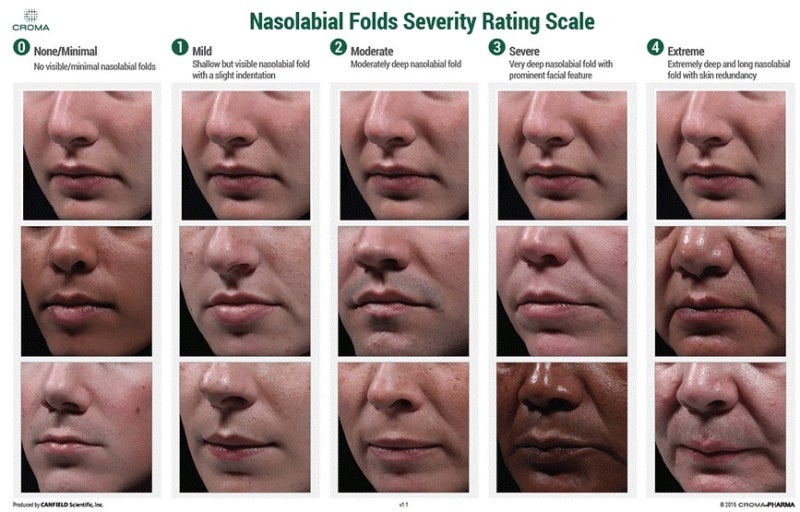
When consulting patients about nasolabial folds, there is one question I hear most often:
‘Can’t I just get smile line fillers?’
While this used to be the standard answer in the past, it is not necessarily true today.
This is because nasolabial folds are:
👉 Rarely just an issue with the fold itself.
👉 More often the ‘result’ of facial structure and sagging.
What Are Nasolabial Folds?
Nasolabial folds, often called smile lines, are creases that resemble the Chinese character ‘八’. They start at the upper border of the nasolabial groove between the nose and cheeks, extending diagonally downward toward both sides of the mouth.
Why Do Nasolabial Folds Form?
Dividing Nasolabial Folds into 3 Types
Recent studies classify nasolabial folds
into three distinct types based on their underlying causes.
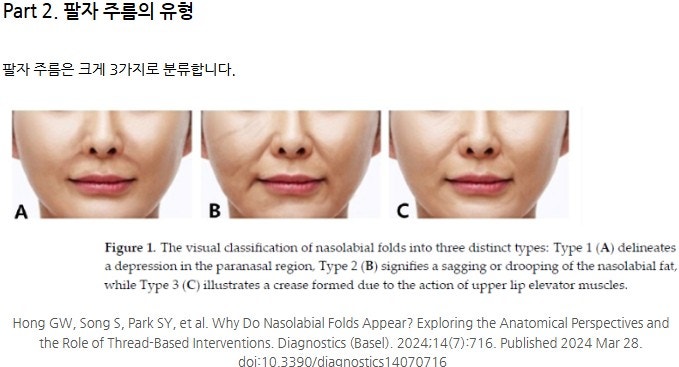
Classification by Cause of Nasolabial Folds
Type 1 (A): Characterized by depression in the paranasal region.
Type 2 (B): Caused by the sagging or descent of nasolabial fat.
Type 3 (C): Formed by the action of the levator labii superioris muscle.
① Type 1 – Hollow-Looking Folds Next to the Nose (Paranasal Volume Deficiency)
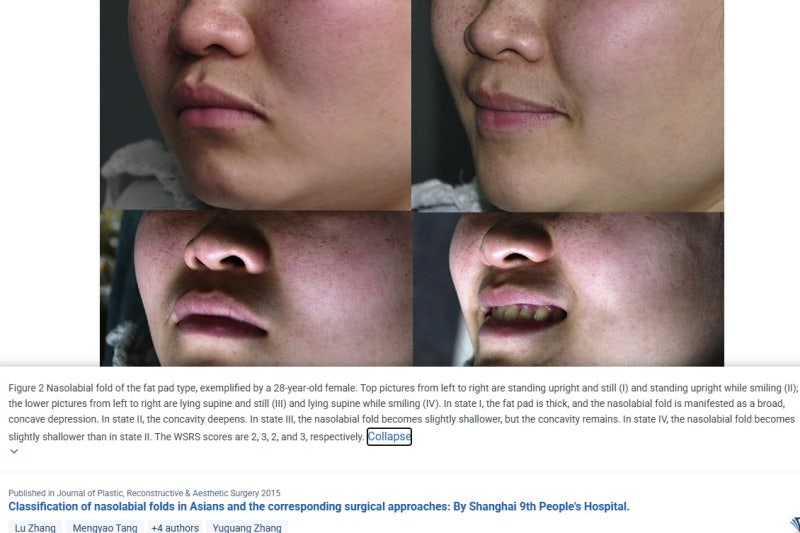
This occurs when the cheek area next to the nostrils becomes hollow, making the nasolabial folds stand out.
The fat below the fold is lacking,
while the fat above the fold is relatively thick,
creating a boundary that looks like a deep wrinkle.
👉 In this case, it is best to naturally fill the structural hollowness rather than just treating the wrinkle (using Radiesse),
while refining the fat above the fold (using Ultherapy, LinearZ, Onda, Titanium, fat-dissolving injections, etc.) to improve the area.
② Type 2 – Folds Caused by Sagging Skin (Nasolabial Fat Sagging)
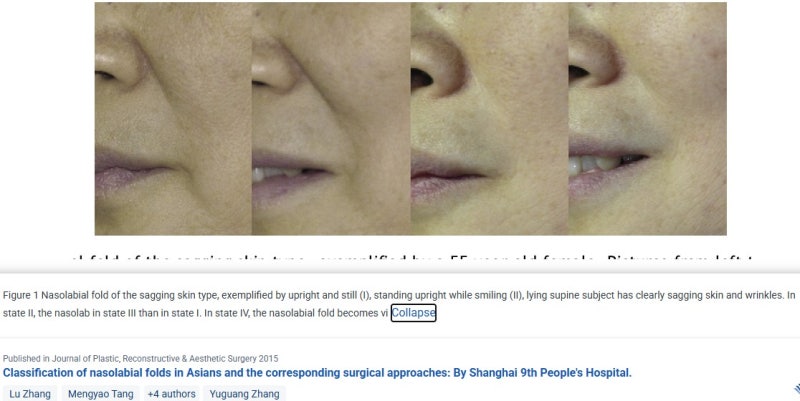
The skin and fat above the nasolabial fold are loose,
while the lower part is firmly anchored.
Over time, only the upper fat slides downward.
Bulging on top,
firm on the bottom
→ This contrast makes the fold appear deeper.
👉 If you simply fill the fold line,
this type can actually look more bulging around the mouth.
In this case, any lifting procedure that improves sagging will be helpful,
such as ultrasound lifting lasers like Ultherapy, thread lifting, Titanium, Onda laser, etc.
③ Type 3 – Folds That Deepen When Smiling (Muscle Action Type)
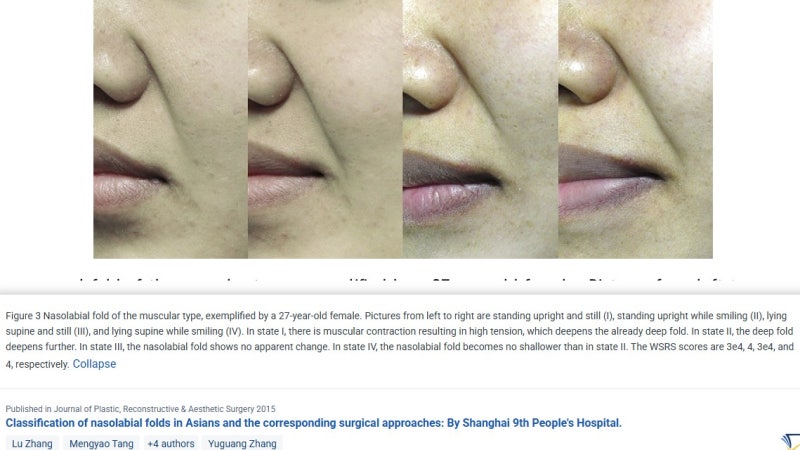
Are you someone whose smile lines get noticeably deeper when you smile?
This happens because the muscle that lifts the upper lip
is directly attached to the skin around the nasolabial folds.
When you smile,
the lower part is pulled in by the muscle,
and the upper fat protrudes more,
→ making the wrinkle look deeper.
When you are young, it only shows when you smile,
but over time, it remains even when your face is resting.
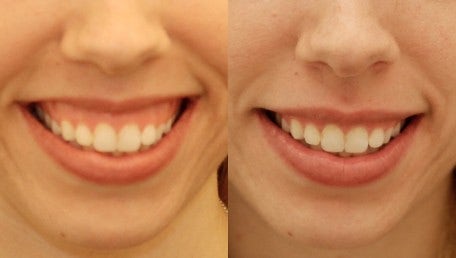
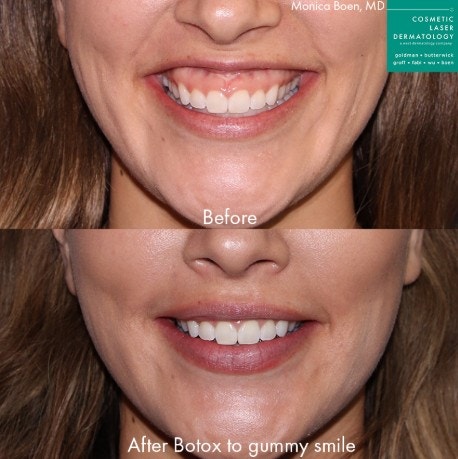
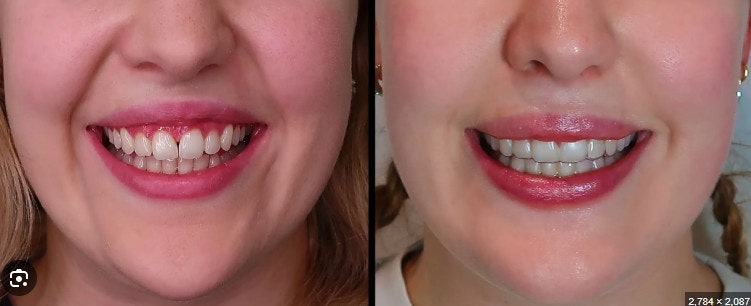
In this case, it is necessary to first control the muscle strength with gummy smile Botox.
This Is Why We Rarely Use Smile Line Fillers Anymore
The majority of nasolabial folds are:
👉 Not a problem with the ‘line’ itself,
👉 But an issue with the surrounding structure.
If you repeatedly fill only the fold area with fillers,
the sides of your mouth may look thick,
your facial expressions can become unnatural when smiling,
and your face may feel heavier over time.
Therefore, nowadays, smile line fillers are used minimally and only when absolutely necessary.
The Core of Nasolabial Fold Treatment: Radiesse
The primary treatment I use for nasolabial folds is
**Radiesse**.
Radiesse works by:
✔ Rather than directly filling the fold,
✔ Firmly supporting the sides of the nose, front cheeks, and mid-face,
✔ And inducing collagen regeneration within the skin
to help naturally soften the nasolabial folds.
In other words, it is not a ‘fold-filling procedure,’
but rather a ‘structure-altering procedure to prevent folds from forming.’
Radiesse Is Especially Suitable If:
Your folds are emphasized by hollowness next to the nose (Type 1).
Your folds have deepened due to sagging front cheeks (Type 2).
You dislike the thick appearance caused by traditional fillers.
You want natural and long-lasting improvement.
So, Do You Never Use Smile Line Fillers?
No, that is not the case.
✔ If there is already a deeply fixed groove,
✔ And the line is distinct even when resting,
a small amount of filler can be used as a supplementary treatment.
However, this is strictly done by:
👉 First establishing the structure with Radiesse,
👉 And then adding only the absolute minimum amount necessary.
Nasolabial Fold Treatment Starts with ‘Analysis’
In Conclusion
For nasolabial folds, the treatment direction changes completely depending on which of the following is the primary cause:
✔ Hollowness
✔ Sagging
✔ Muscle action
That is why when I examine nasolabial folds,
I do not just look at the wrinkle itself, but consider the entire facial structure.
The core of treating nasolabial folds is:
❌ Not about how much you fill,
⭕ But about where you provide support.
Modern treatments for nasolabial folds are rapidly shifting
from filler-centric approaches → to structural volume & collagen regeneration.
An accurate analysis of the causes specific to your face
will yield the most natural and highly satisfying results.