2026-07-03
Why Does Melasma Occur?
Melasma is a complex skin microenvironment disorder, not just a pigmentation issue. This article explains its causes, mechanisms, and why a comprehensive treatment approach is essential.
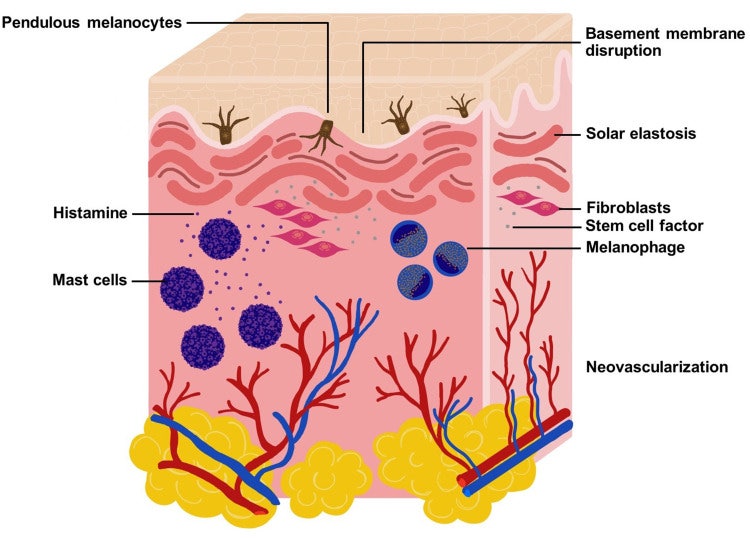
From the mechanisms of melasma to treatment directions (Based on scientific papers)
There is a question that patients visiting the dermatology clinic ask very frequently.
‘Doctor, why do I get melasma?’
It is easy to think of melasma as a simple problem caused by an excess of pigment.
However, according to recent studies, melasma is not merely a pigmentary disorder, but a complex condition that occurs as the entire skin environment changes.
Today, we will summarize:
✔ Why melasma occurs
✔ What happens inside the skin
✔ Why it is so difficult to treat
1️⃣ What is Melasma?
Melasma is:
✔ Symmetrical brown pigmentation on the face
✔ Primarily occurring on the cheekbones, cheeks, forehead, and around the mouth
✔ A pigmentary disorder that is much more common in women.
It is especially prevalent among women in their 30s to 50s, and the following factors act in combination:
UV exposure
Hormonal changes
Skin inflammation
Genetic factors
Skin barrier damage
Typical Distribution
1️⃣ Centrofacial type
Forehead
Cheekbones
Nose
Around the mouth
2️⃣ Malar type
Centered on both cheekbones
3️⃣ Mandibular type
Jawline
Melasma is characterized by symmetrical brown pigmentation and typically develops in areas that receive a lot of sunlight.
2️⃣ Melasma is Not Just a Simple Pigment Problem
In the past, melasma was simply considered
‘a state of excessive melanin production.’
However, recent research has revealed that the following changes occur simultaneously in melasma-prone skin.
In melasma skin, the following occur together:
✔ Increased melanocyte activity
✔ Increased skin inflammation
✔ Increased vascularity
✔ Basement membrane damage
✔ Dermal structural changes
In other words, melasma is
‘not a simple pigmentary disorder, but a disease of the skin microenvironment.’
3️⃣ The Mechanism of Melasma Development
Recent studies have shown that melasma is ‘a state where the entire skin environment has changed.’
The following changes appear simultaneously in melasma skin.
✔ Increased melanin production
✔ Increased dermal inflammation
✔ Increased vascularity
✔ Skin barrier damage
✔ Collagen structural changes
Therefore, melasma can be viewed as a problem of the skin ecosystem rather than a simple pigment issue.
Looking at the process of melasma development step by step:
① UV Stimulation
The most important cause of melasma is **ultraviolet (UV) rays**.
When UV rays penetrate the skin,
keratinocytes secrete various signaling molecules.
Typically, these include:
α-MSH
Endothelin
Stem cell factor
These substances stimulate the melanocytes.
② Melanocyte Hyperactivity
In stimulated melanocytes,
tyrosinase, the enzyme responsible for melanin production, becomes activated.
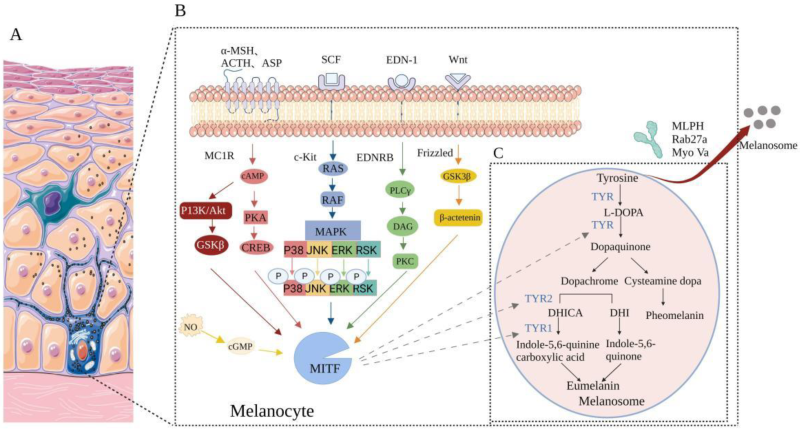
During this process,
Tyrosine
↓
DOPA
↓
Melanin
melanin is produced through this pathway.
The produced melanin is transferred to surrounding keratinocytes, causing the skin to appear darker.
In melasma skin, this process is excessively activated,
leading to an overproduction of melanin.
③ Inflammatory Response
Recent research has revealed that inflammation is a crucial cause of melasma.
When exposed to repeated UV rays or external stimuli,
a chronic inflammatory response occurs in the skin.
At this time, the secreted
inflammatory cytokines
and various inflammatory mediators
continue to stimulate the melanocytes.
Therefore, melasma is not just an increase in pigment,
but a condition where pigmentation worsens as inflammation persists.
④ Basement Membrane Damage
The skin has a structure called the **basement membrane, which separates the epidermis and the dermis**.
This structure plays a role in keeping melanin confined to the epidermis.
However, continuous UV exposure and inflammation weaken and damage the basement membrane.
When the basement membrane is damaged, melanin drops into the dermis,
resulting in **dermal melasma**.
In this case, the pigment is deeper, making treatment much more difficult.
⑤ Increased Vascularity
Recent studies also report an increase in blood vessels observed in melasma skin.
In particular, an increase in a substance called VEGF (vascular endothelial growth factor)
promotes the formation of new blood vessels.
This process is associated with
increased melanocyte activity
and enhanced inflammatory responses,
which can influence the formation of melasma.
That is why, when examining the skin of melasma patients,
you may sometimes see a slight redness along with the pigmentation.
4️⃣ Why Melasma Treatment is Difficult
Melasma is not a condition that can be resolved simply by reducing melanin.
In melasma skin,
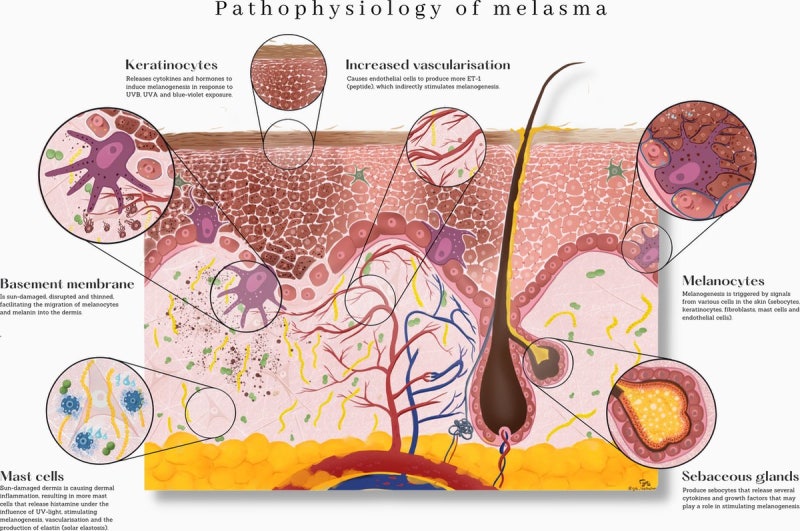
✔ Increased melanin
✔ Inflammation
✔ Vascular changes
✔ Basement membrane damage
✔ Dermal structural changes all exist simultaneously.
Therefore, melasma treatment
‘requires an approach that improves the overall skin environment, rather than just removing the pigment.’
5️⃣ The Most Important Aspect of Melasma Treatment
Melasma treatment is
‘closer to managing a condition rather than eliminating it all at once.’
✔ UV protection
✔ Skincare correction and lifestyle improvements
✔ Skin barrier management (Radiofrequency: Thermage, Serf, Density + Collagen boosters: Juvelook Volume, Radiesse + Rejuran, LDM)
✔ Appropriate laser treatments (Fotona/Hollywood Laser, Pico Toning Laser, and in some cases, Neobeam, Vbeam, Potenza)
When these are carried out together, melasma can be stably managed.