2026-07-03
Why Under-Eye Fillers Look Bluish (Causes of the Tyndall Effect Under the Eyes)
Learn why under-eye fillers can cause a bluish Tyndall effect and how proper injection depth and skin treatments can resolve it.

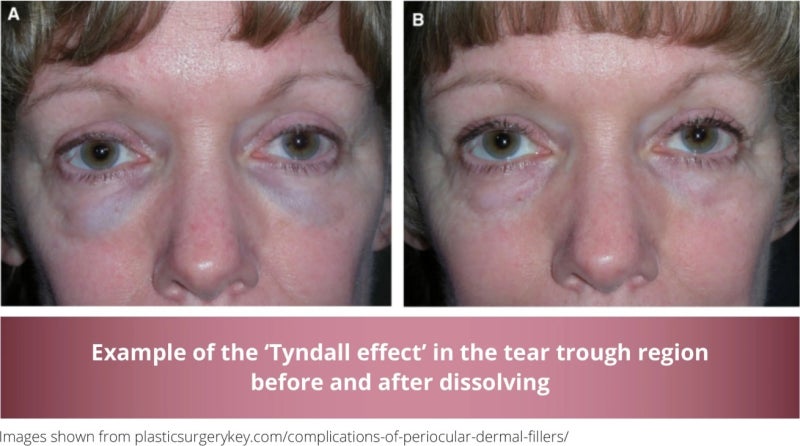
The most significant cause is when the filler is placed in a layer that is too superficial.
The skin under the eyes is one of the thinnest areas on the face.
When filler is placed right beneath this thin skin, light is scattered by the filler particles,
causing it to appear blue or gray.
This phenomenon usually
appears as a long line
or is localized in specific areas.
However, this explanation alone is insufficient.
Interestingly, the explanation for this Tyndall effect is not entirely definitive.
According to research, the particle size of hyaluronic acid fillers is much larger than the wavelength of visible light.
Theoretically, it should reflect all colors equally and appear white.
In other words, it is a phenomenon that cannot be fully explained simply by ‘light scattering’.
More Important Causes in Actual Clinical Practice
The phenomenon that looks like the Tyndall effect is caused by a combination of several factors:
1. When the skin is too thin
Because the under-eye area is structurally thin, even a slightly superficial injection can easily show through.
2. Filler placement issues
When placed in a layer that is too superficial or in a shallow plane above the muscle.
3. Interaction with surrounding tissues
Blood vessels, pigment, and skin structure can be subtly distorted by the filler, making the color appear darker.
4. Type of filler
Fillers with large particles are more likely to be visible in superficial layers.
However, since there are reports of this occurring with non-particulate fillers as well, it is difficult to view it simply as a product issue.
Therefore, the key is ‘depth’.
The most important aspect of under-eye fillers is not how much is injected, but which layer it is injected into.
When accurately placed in a deep layer (above the bone), light scattering is reduced, resulting in a natural appearance.
Conversely, if placed in a superficial layer, the Tyndall effect can occur even with a small amount.
How to Resolve the Tyndall Effect
If the Tyndall effect has already occurred, it is not enough to simply ‘remove’ it;
you must also consider why this phenomenon happened in the first place.
Fundamentally, the safest method is to remove the existing filler using hyaluronidase
and then re-inject it into the correct layer.
However, there is one more important point to note here.
The under-eye area naturally has very thin skin, and if the Tyndall effect has occurred,
it often means the skin is exceptionally thin and lacks density.
If filler is immediately re-injected under these conditions, the same problem is likely to repeat.
Therefore, in actual clinical practice, rather than simply re-injecting the filler,
it is crucial to first improve the skin’s thickness and density.
This is done by increasing skin elasticity through radiofrequency lifting like Eye Thermage or Eye Sherf,
and combining it with skin boosters such as Eye Rituo, Juvelook Eye, and, if necessary, Rejuran Eye
to improve the density and condition of the dermal layer.
When this ‘groundwork’ is done beforehand, even a very small amount of filler used later
can yield much more natural and stable results.
Ultimately, what matters is not how much filler is injected, but first creating an environment where the filler can be properly placed.
Conclusion
The commonly known Tyndall effect in under-eye fillers is less of a simple ‘light scattering’ phenomenon
and more the result of a complex combination of superficial placement, thin skin, and tissue interaction.
Therefore, accurately understanding the depth and structure rather than just the amount of filler, and performing the procedure accordingly,
is the most important prevention method.
Summary in One Line
A bluish change under the eyes is a sign of incorrect filler placement, not just a simple color issue.