2026-07-03
Does Hyaluronidase Cause Facial Volume Loss? The Myths and Truths Confirmed by Research Papers
Discover the truth about hyaluronidase (filler dissolver). Medical research confirms it safely treats filler complications without permanently damaging natural skin tissue.

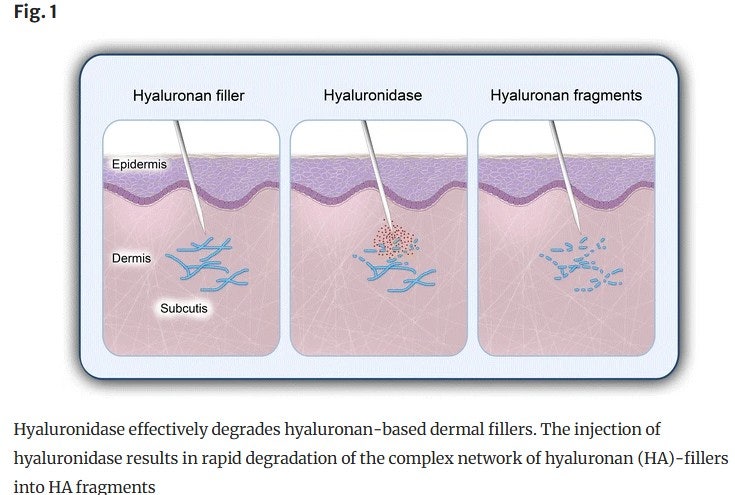
After getting dermal fillers, patients sometimes say, ‘I think it looks a bit too much,’
‘It feels lumpy,’ or ‘I think I looked better before.’
In these situations, the most frequently mentioned medication is **Hyaluronidase**.
However, during consultations,
I often hear these common concerns from patients:
‘I heard that getting hyaluronidase makes your face lose volume.’ ‘They say it dissolves all your natural hyaluronic acid and ruins your skin.’
In reality, if you look at the internet, community forums, and review posts,
there are quite a few cases where excessive fear has been built up around hyaluronidase.
So today, rather than relying on feelings or personal anecdotes, I want to clarify what kind of drug hyaluronidase actually is based on medical research papers.
Hyaluronidase Caveats in Treating Filler Complications
Landau, Marina MD
Dermatologic Surgery 41():p S347-S353, December 2015. | DOI: 10.1097/DSS.0000000000000555
According to a review paper by Landau et al.,
hyaluronidase is the most effective treatment for hyaluronic acid filler complications,
and there is no reported clinical evidence that it permanently damages the hyaluronic acid in natural skin tissue.
✅ 1. Hyaluronidase is an essential medication for treating filler complications
In complication scenarios caused by hyaluronic acid fillers, such as:
Vascular occlusion
Risk of skin necrosis
Excessive volume, asymmetry, and lumpiness
Hyaluronidase is the most effective and rapid treatment method.
👉 The paper explicitly states that there is currently no alternative to hyaluronidase for treating filler complications.
✅ 2. There is no evidence that hyaluronidase permanently damages ‘natural skin hyaluronic acid’
The paper clarifies the following:
There is no scientific evidence that hyaluronidase permanently destroys the hyaluronic acid (native HA) present in natural skin tissue,
accelerates skin aging,
or causes long-term degradation of skin quality.
👉 Regarding the concern raised by some that
‘getting hyaluronidase makes your face lose volume and ruins your skin,’
it concludes that there is no clinical or scientific evidence to support this claim.
✅ 3. The action of hyaluronidase is localized and temporary
Hyaluronidase only acts near the injected area.
Enzyme activity decreases within a short period of time.
Hyaluronic acid in the body is a substance that is continuously synthesized and regenerated.
Therefore, even if some natural HA is temporarily degraded by hyaluronidase,
👉 it is explained that it recovers quickly physiologically.
✅ 4. The problem is not ‘hyaluronidase itself,’ but how it is used
The author summarizes the risks of hyaluronidase as follows:
❌ It is not because hyaluronidase is dangerous,
⚠️ but rather indiscriminate dosages, inaccurate anatomical understanding, and unnecessary repeated use are the problems.
In other words,
if the indications are clear,
based on anatomical understanding,
and it is used only as much as needed in the necessary areas,
👉 it concludes that hyaluronidase is a safe and highly useful tool.
✅ 5. Delaying treatment out of fear of hyaluronidase is more dangerous
Especially in situations involving vascular complications,
hesitating to use hyaluronidase
or delaying administration due to excessive worry about natural HA damage
👉 is warned to actually increase the risk of tissue damage and scarring.
🧠 One-sentence summary of the paper’s conclusion
Hyaluronidase is an essential medication in the treatment of hyaluronic acid filler complications, and there is no evidence that it permanently damages natural skin hyaluronic acid. What is dangerous is not hyaluronidase, but its incorrect use.